As a Vanguard, I’ve been introducing Conquest to my FLGS, the fantastic Geeky Teas in Burbank. Much of those introductions have involved demos and games of First Blood, and over the course of these demos I’ve formed an initial opinion of the game. I want to talk about First Blood here as honestly and as kindly as I can, because it’s a great game made by great people, so please don’t ascribe any malice to this writing. I very much don’t intend it.
Introduction
In the dozen or so demo games that I’ve given to players both experienced and new to wargames, I have found that First Blood is a tough sell, much tougher than the Rank-and-file game Para-Bellum offers, The Last Argument 0f Kings (which I’ll call Last Argument from now on). Part of the reason for this is Last Argument has a larger community, part of it is because rank-and-file games have fewer competitors, but I also think there are some key challenges that First Blood has to deal with in order to become a better game.
I think Para-Bellum (as of Winter of 2024, when this is published) know that First Blood is in need of improvement, and want to do something about it, and I’m writing this in part because I hope it helps start a conversation in the community around some directions that First Blood can go.
In this post, I’ll first lay out my hypothesis for why First Blood is currently in a tough spot, and then I’ll go into some of the solutions that could address some of the challenges I see, along with my proposed solution.
The Problem
The key challenge that First Blood has to deal with is that it’s trying to accomplish three different objectives at the same time. That is to say, I see First Blood as trying to be the following different things to a prospective player:
- Compatible with the higher-model count rank and file game Para-Bellum produce, The Last Argument of Kings. It uses the same models and the same basic statlines and borrows many of the mechanics of Last Argument.
- A skirmish-plus game. It rewards larger units consisting of 12 models, and is balanced around a point value that expects 20-30 models.
- A competitive game. It’s recent billing is as a game with a Worlds Circuit whose players will eventually go to Chios
While these three objectives are not inherently incompatible, the design decisions that have been made to meet these objectives don’t work together well. I’ve even made a handy chart to explain what I mean (see below).
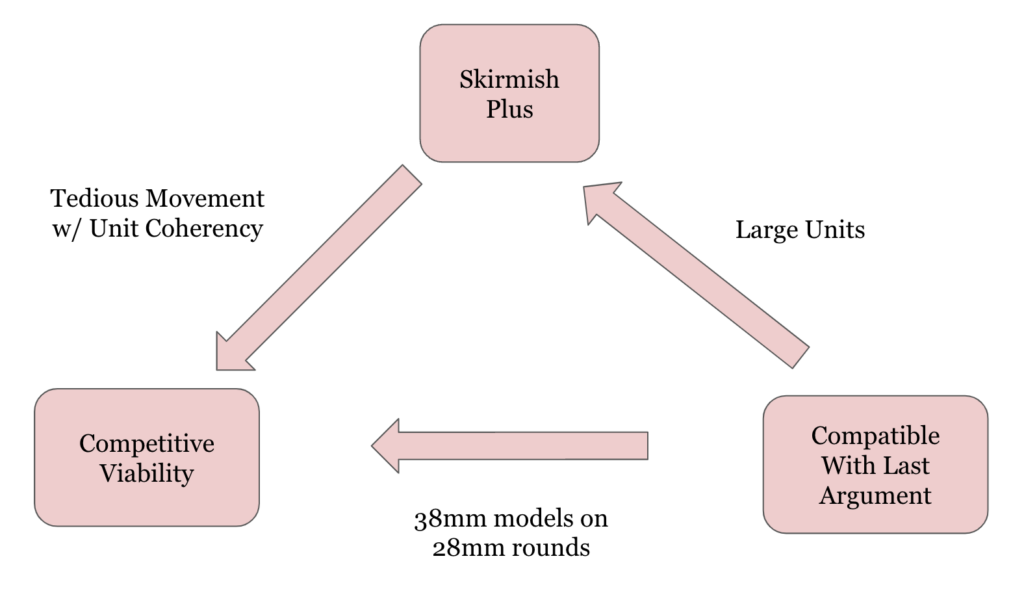
Let’s start with the first design interaction: inter-system compatibility. While I do think maintaining compatibility with Last Argument is a great idea and an excellent way to get twice the value out of the same number of SKUs, it just hasn’t been implemented in a way that helps First Blood as a game. Key among these design decisions is that it’s pretty clear that the designers have balanced their game around the “skirmish-plus” format, where armies aren’t quite Last Argument size, but they still involve armies with 30+ models consisting of units of 6-12 models moving in some form of coherency and acting in tandem.
Compare this with smaller skirmish games that typically have warbands consisting of around 10 models, where each model acts individually.
How does the skirmish-plus design manifest itself? First Blood sets the minimum size for an infantry unit at four models, the size of a single regiment stand in Last Argument, and requires that a unit has to be 12 models, the size of a minimum sized regiment in Last Argument, to unlock a standard bearer model. These numbers seem to be chosen to match the Last Argument values, with the idea that by mapping one-to-one to Last Argument it makes the crossover easier. To be clear, there’s nothing inherently wrong with the skirmish plus format, but when combined with some other design decisions it leads to a poor gaming experience, especially at large army sizes.
It’s both the desire for compatibility and the skirmish plus size that make First Blood a difficult game to make competitively viable. The biggest challenge for First Blood competitive viability is that infantry consist of 38mm scale models on 28mm bases. The use of these 28mm rounds is so that they still slot into the 66mm movement trays and can participate in Last Argument battles, but as a result, the models crowd over their bases, their details obscure the border of that base and make it hard to position other models nearby, or accurately measure base to base distances. In a competitive system, the base is the reference for the rest of the game, and in order to measure from it you have to navigate around a model that often obscures it quite a bit.
In fact, when I gave a demo in the recent past to two people who had never played wargames before, the first thing they did while playing was fashion a small 5″ measuring stick out of a folded piece of paper, because navigating a tape measure among all of the spears and axes and other bits was too clumsy.
Combine clumsy measuring with large model counts, each of which move independently, and you have a recipe for tedious, frustrating movement phases, contentious measurements of unit ranges and clearances, and overall a less enjoyable experience.
Band Aids
There are a few easy solutions that I think accomplish the objectives that Para-Bellum have for the game without causing too many problems.
First, I think its more effective to make a simplified version of Last Argument as an on ramp to that game, rather than trying to shoehorn this sort of feature into a skirmish game. The recent decision by Games Workshop to expand the Combat Patrol / Spearhead format and promote Kill Team / Warcry as their own standalone games gives an indication of some of the lessons being learned in a similar space. That is, I propose that a far more effective on-ramp for a game like Last Argument would be a smaller version of the game that still uses rank-and-file regiments, fixed unit lists, and streamlined rules, as opposed to a separate skirmish style game.
Second, First Blood could be a competitively viable game, but it needs to add the affordances necessary to make competitive play feel clean. Fortunately, there are solutions. For instance, a typical Warmachine model, which is the closest game in spirit to large-scale First Blood, includes a large fillet on the bases. This 3mm bumper provides the clearances necessary to allow for measuring, and offsets the model far enough from the edge that a measuring tool can get between the sculpt and the base to measure distances accurately.1 Even Last Argument adds this sort of buffer to the movement trays, since those trays (attempt to) offset the models from the point of measuring/contact. Para-bellum could simply sell a little 32mm or 35mm round that the 28mm round slots into, perhaps even with a little magnet hole. These rounds would provide the necessary reference to allow players to perform all of the measurements necessary.
However, I think neither of these solutions address the potential of First Blood as a game that is fully differentiated from Last Argument. There is a solution that 1) allows players to develop key parts of their armies for Last Argument 2) retains the signature elements of a skirmish game.
The solution is a 10 model narrative skirmish game, and I’ll explain why.
The Solution
There are a few reasons why I think this direction is a good idea.
- 10 models: instead of trying to make all of the regiments of Last Argument viable, instead focus on the command stands. That is, allow the player to save their best paint jobs on the characters, the officers, and the unit leaders/standard bearers, and make sure those models see play in both games. Focus on a few key models lets the players build a relationship with the core of their armies first, then lets them build up the forces for Last Argument with the rest later.
- Narrative: the playerbase is hungry for it. Lore and Narrative are a key part of the appeal of Conquest, the world that Stavros dreamed up is exciting and interesting and there just isn’t enough lore content out there. While I do think the TTRPG will be an excellent and welcome addition to the ecosystem, a narrative-based skirmish game that allows one to integrate that lore with the existing models that have already been so lovingly crafted is an easy sell.
- Story Centric: We’ve established that the model size versus base size isn’t a recipe for a competitively smooth game. Relax that requirement by instead focusing on story when playing instead of precision. This also opens up the design space, allowing for more exciting character interactions that better use problem solving outside of combat to win games. For instance, a game like Frostgrave has spells for making bridges, moving objects telekinetically, and adding runic traps to terrain. A more narrative First Blood wouldn’t need to balance narrative-rich spells like these in a competitive environment, and could introduce more interesting abilities than the ones many characters currently have.2
The best way for a design to move forward is to get something on the table (ha!) that can be critiqued, and so in that vein I’ve introduced my own modified ruleset to First Blood called Bloodgrave. Bloodgrave takes significant inspiration from Frostgrave both in premise (small warbands exploring a ruined city) and in philosophy (character focused, fewer models, group activation). It still tries to retain compatibility with the overall First Blood ruleset as much as it can, but I am considering adding more optional rule modules that help First Blood function as a game with smaller model counts. I’ve gotten excellent positive feedback from the community as a whole on this ruleset, and I’m always interested in getting more insights from people who have played the game. Feel free to send me a message if you have any thoughts about this post or Bloodgrave as a whole..
Closing
Imagine the Conquest Event of the future. You have your Last Argument tournament, with the big names in the community duking it out for a chance at Chios. Simultaneously, you have your First Blood narrative event. The boards are lush with terrain- it’s all bio-engineered warrens, crumbling aqueducts, philogiston refineries. Each board is the site of a different Living World campaign whose culmination is at this event. Choices that players around the world have made over the past two months have informed the layout of the boards, the perks each side has access to, the stakes of the engagement. These scenarios are also online, for those who couldn’t make the trek to also contribute to the story. At the end of the event, the winners of the scenarios help shape the world of Eä, and the Best Painted warbands get featured on the website. Maybe even some of those players get to go to Chios for one worldwide narrative event.
Footnotes
- Also I want to be clear, Warmachine is as guilty as any of these game producers of scale creep, and many of the models can overhang their bases quite a bit, bumper or not. The problem is particularly bad with Conquest, however. This is because all infantry are on 28mm rounds regardless of their size, and this leads to problems in ranking up even for Last Argument games. I do think they should introduce an elite infantry model that is 2 to a stand and on a 32mm round to deal with this issue. That’s a whole different blog post however. ↩︎
- There are a few characters that have genuinely interesting abilities in the present version of First Blood. My current favorites are: the Lineage Prideborne being able to power up every time it kills a model, the inquisitor being able to “mark” models, and the Sorcerer Kings’ ability to sacrifice models to chain spells and power them up. I’d love to see more super cool, thematic abilities like these, but abilities like “+X to number of models seizing an objective” or “this unit gets blessed” are so much easier to balance.. ↩︎